
how to reduce tilt in ranked games usually comes down to one thing: catching the emotional spiral early, before it hijacks your decisions. Tilt is rarely “just bad luck.” Most of the time it’s a predictable chain reaction—one mistake, one teammate conflict, one unlucky fight—then your brain starts chasing control with riskier plays.
Ranked makes tilt feel heavier because every match seems to “mean something.” Your time, your MMR, your identity as a player. That pressure is exactly why small habits matter, the boring ones you do before you’re upset, not the heroic ones you try after you explode.
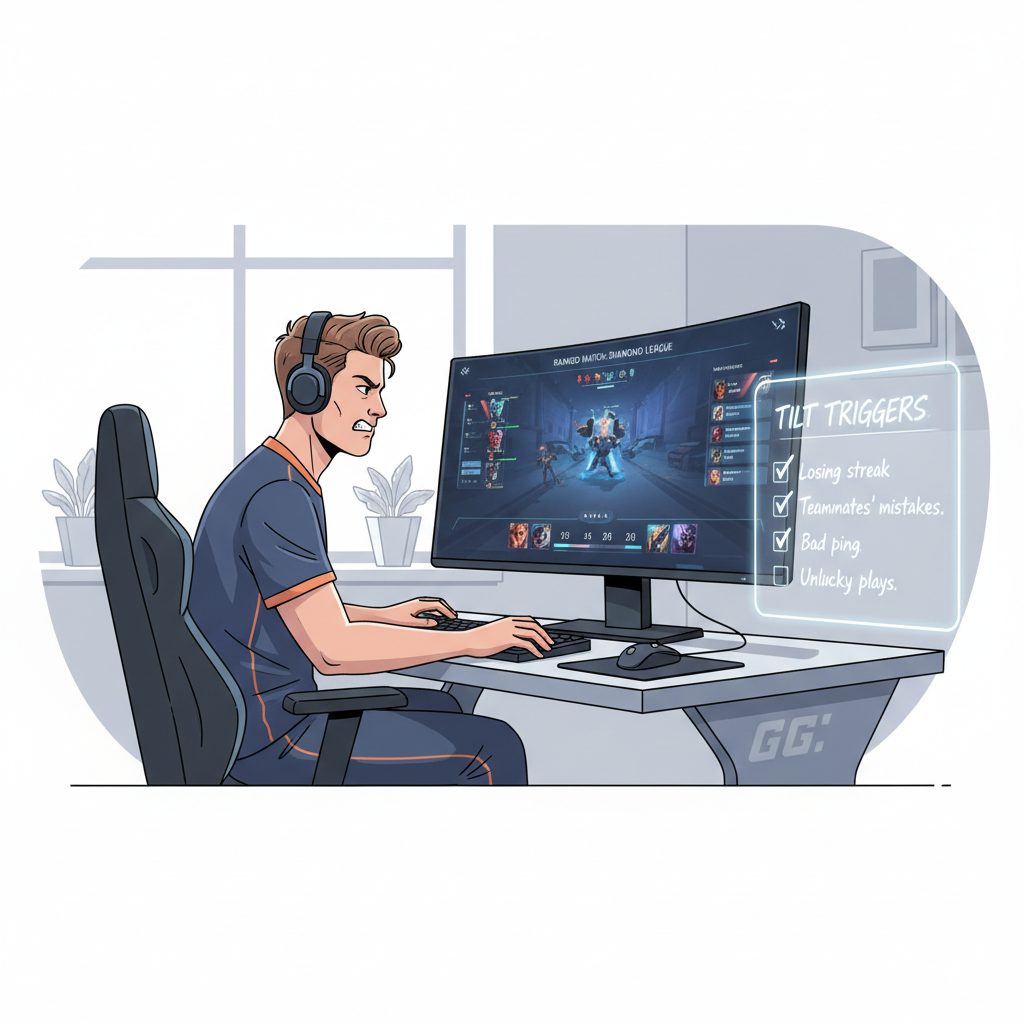
What this guide does is practical: you’ll get a quick way to identify your tilt pattern, a between-game reset that actually fits ranked queues, and a few “in-the-moment” scripts that stop you from feeding, typing, or rage-queueing. No perfection required, just consistency.
What tilt really is (and why ranked amplifies it)
Tilt is a performance drop caused by emotional overload—frustration, anger, anxiety, embarrassment—plus the urge to “fix it right now.” In ranked, the stakes feel higher, so your brain interprets mistakes as threats instead of feedback.
According to the American Psychological Association (APA), stress can narrow attention and reduce flexible thinking. In gaming terms, that looks like tunnel vision, forcing fights, ignoring timers, and making the same mistake faster.
Ranked also stacks triggers: long sessions, repeated coin-flip moments, and social pressure from teammates. You’re not “weak” for tilting; you’re human in a high-feedback environment.
Common causes of tilt in ranked games (real scenarios)
Different games create different tilt flavors, but the patterns repeat across MOBAs, shooters, and fighting games. Here are the big ones that show up in ranked ladders.
- Expectation mismatch: you expect teammates to play “correctly,” they don’t, and your brain treats it as sabotage instead of variance.
- Outcome obsession: you focus on rating points, not decisions, so every death feels like a personal loss.
- Revenge queueing: one bad game turns into “I have to get it back,” which is emotion driving the queue button.
- Identity threat: you think “I’m better than this rank,” so any loss feels like proof you’re not.
- Communication spirals: you type to correct, someone bites back, and now you’re playing the chat instead of the map.
- Decision fatigue: late-session ranked turns small problems into huge irritations because your self-control runs low.
If you want to know how to reduce tilt in ranked games, start by naming which of these hits you most often. Tilt management is easier when it’s specific.
A quick self-check: are you tilted, tired, or just playing poorly?
This matters because the fix changes. A bad day mechanically needs reps. Tilt needs a reset. Fatigue needs a break.
10-second tilt checklist
- You feel rushed, like you must “make something happen” immediately.
- You’re re-living the last mistake while the current fight starts.
- You’re tempted to type, ping spam, or “teach” someone a lesson.
- You take lower-percentage fights than you normally would.
- You’re thinking about points, rank, or promos mid-match.
If you hit 2+ items, treat it as tilt and run a short reset. If you hit none but your hands feel slow, it’s likely fatigue. If you feel fine but misplay one specific skill repeatedly, that’s a practice issue.
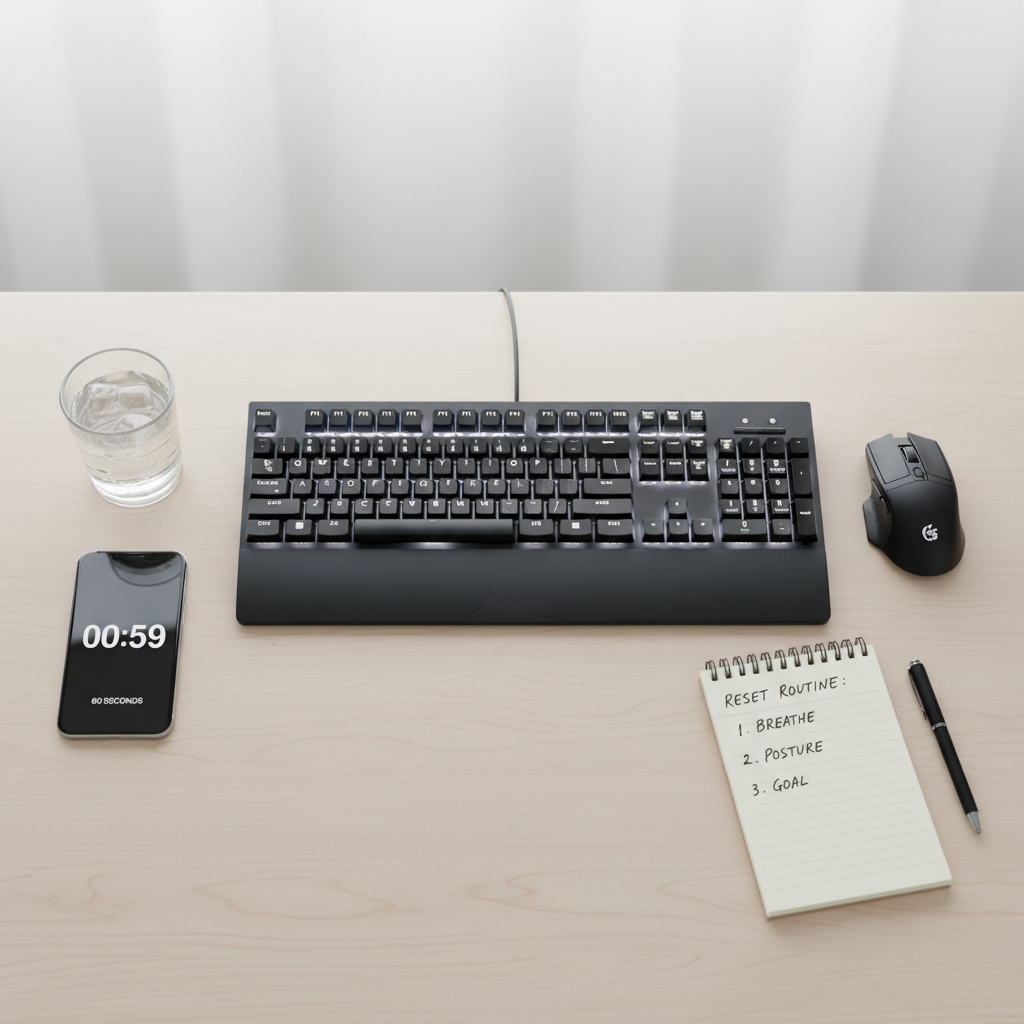
The between-game reset that fits real ranked queues (60–120 seconds)
You don’t need a 20-minute meditation to stop tilt. You need a repeatable micro-reset that breaks momentum. Here’s a routine many competitive players use in some form because it’s short enough to actually do.
Step 1: Name the emotion (5 seconds)
Say it out loud: “I’m frustrated,” “I’m anxious,” “I’m embarrassed.” It sounds corny, but labeling reduces intensity for many people because it stops the vague swirl.
Step 2: Change the body input (20 seconds)
- Unclench jaw, drop shoulders, open hands.
- One slow inhale, longer exhale, repeat 3 times.
- Drink water or stand up briefly.
You’re telling your nervous system “we’re not in danger,” which makes better decisions more available.
Step 3: Set a one-line process goal (10 seconds)
Not “win next,” but “track ult economy,” “play for trades,” or “no solo peaks.” Process goals are how you get back to control without chasing outcomes.
Step 4: Decide the queue rule (10 seconds)
If you’re still heated, you don’t negotiate with yourself. Use a preset rule like: two losses in a row = 10-minute break, or one toxic game = stop ranked. It removes the debate.
In-game tools: stop the spiral without throwing the match
The real challenge is mid-match, when you’re already tilted and the game keeps demanding decisions. These are low-friction interventions that don’t require perfect calm.
Use “next play” language
After a mistake, force one sentence: “Next play: farm safely for 90 seconds” or “Next play: hold angle and don’t swing”. You’re redirecting attention from blame to action.
Mute earlier than you think
If chat or voice reliably triggers you, muting is not “giving up teamwork,” it’s protecting decision quality. Many games still allow pings, quick wheels, or limited callouts. If you know you spiral when criticized, pre-mute is often smarter than “I’ll be fine this time.”
Play the lowest-variance option for 2–3 minutes
- Shooters: hold a safer angle, trade, stop ego-peeking.
- MOBAs: catch waves, ward, avoid coin-flip fights.
- Fighting games: pick solid spacing, reduce risky reads.
This is how to reduce tilt in ranked games while still trying to win: you lower volatility until your brain catches up.
Build a tilt-proof ranked routine (so you need fewer rescues)
Most tilt “solutions” fail because they start after you’re already angry. A simple routine makes tilt less frequent and shorter when it hits.
Pre-ranked warm-up: 8–12 minutes
- 2 minutes: check posture, water, temperature, distractions.
- 3–5 minutes: mechanics drill or aim trainer, light intensity.
- 3–5 minutes: one unranked, deathmatch, or training mode to lock timing.
The point is not skill gain, it’s reducing “first game chaos,” which often triggers early tilt.
Session caps that prevent the cliff
- Time cap: stop ranked at a set time, even on a win.
- Loss cap: stop ranked after 2–3 losses, depending on how fast you tilt.
- Emotion cap: if you feel shaky or angry, you exit ranked, period.
According to the National Institute of Mental Health (NIMH), stress responses can affect concentration and decision-making. In practice, caps protect you from playing your worst games when your brain is most reactive.
Quick reference table: symptom → likely cause → what to do
If you want a simple on-screen reminder, this table is the “save the session” version.
| What you notice | Likely cause | Best next action |
|---|---|---|
| Typing/pinging more than playing | Control seeking, social trigger | Mute, set one process goal, play low-variance |
| Chasing kills or forcing fights | Outcome obsession, revenge mode | Reset breath, “next play” sentence, stabilize for 2 minutes |
| Hands feel slow, aim off, late reactions | Fatigue, overload | End session or take a 10-minute break, hydrate |
| Thinking about rank constantly | Identity threat, anxiety | Switch to process metric: positioning, economy, cooldown tracking |
| One mistake makes you “done” | Perfectionism, shame loop | Short self-talk script: “Playable game, one step at a time” |
Common mistakes that keep tilt alive
Some “advice” sounds tough, but it quietly makes tilt worse. These are the traps I see most often in ranked communities.
- Trying to win your mood back: queuing again to feel better is understandable, but it often locks you into revenge decision-making.
- Venting in chat: even “polite” criticism usually costs more focus than it earns in coordination.
- Changing everything after one loss: new sensitivity, new hero, new role, new settings—sometimes it works, often it’s panic.
- Reviewing while emotional: vod review mid-tilt turns into self-attack, save it for later when you can be curious.
- Using caffeine as a fix: it can help alertness, but too much often increases anxiety and impatience, especially late.
If you keep hitting the same wall, the answer is rarely “more willpower.” It’s usually a better rule set, earlier muting, and shorter sessions.
When tilt might be more than a gaming problem
If ranked anger starts spilling into sleep, work, relationships, or you notice panic symptoms, it may help to talk with a qualified professional. Gaming can be a stress outlet, but it can also become a stress amplifier when life pressure is high.
According to the Centers for Disease Control and Prevention (CDC), managing stress often includes sleep, movement, social support, and professional care when needed. If you feel stuck in constant irritability or anxiety, getting support is a strong move, not an overreaction.
Key takeaways you can use tonight
- Catch tilt early: if you hit 2+ checklist signs, reset immediately.
- Use a micro-reset: label emotion, change body input, set one process goal.
- Lower variance mid-tilt: safe plays for 2–3 minutes buys your brain time.
- Make rules before emotion: loss caps and time caps prevent rage-queueing.
If you’ve been searching for how to reduce tilt in ranked games, your best next step is simple: pick one queue rule and one reset script, write them down, and run them for a week without negotiating.
FAQ
How do I stop tilt after a teammate throws?
You can’t undo the throw, but you can stop it from becoming a second loss through bad decisions. Mute fast, switch to a stabilizing plan, and treat the match as practice for discipline under chaos.
Is it better to take a break or keep playing to “push through”?
If you feel emotionally charged, breaks usually help more than pushing through. If you’re calm but rusty, playing one more game can be fine. The key is whether your decisions feel rushed and revenge-driven.
What’s the fastest way to calm down between ranked matches?
A 60–120 second routine works for most players: label the emotion, breathe with longer exhales, set a one-line process goal, then decide if you’re re-queueing based on a rule, not a feeling.
Does muting chat hurt my win rate?
It depends on the game and your role, but many players perform better with fewer social triggers. If chat makes you argue or second-guess, muting can improve consistency even if you lose occasional callouts.
How can I reduce tilt if I care a lot about rank?
Caring isn’t the issue, attaching your self-worth to every match is. Convert “rank anxiety” into a process metric you can control, like trading discipline, cooldown tracking, or positioning rules.
Why do I tilt more on losing streaks than single losses?
Streaks create a story in your head, like the ladder is “against you,” and that story pushes riskier choices. Loss caps interrupt the narrative before it becomes your whole session.
Should I vod review right after a tilting loss?
Usually not. Right after a tilt loss, review tends to become blame or self-criticism. Save it for later, then look for one fixable pattern, not every mistake.
If you’re trying to climb but keep getting derailed by emotions, a small toolkit often beats big motivation. If you want a more hands-off approach, consider setting up a simple ranked “playbook” you can reuse—reset routine, mute rules, session caps—so your best habits show up even on bad days.